
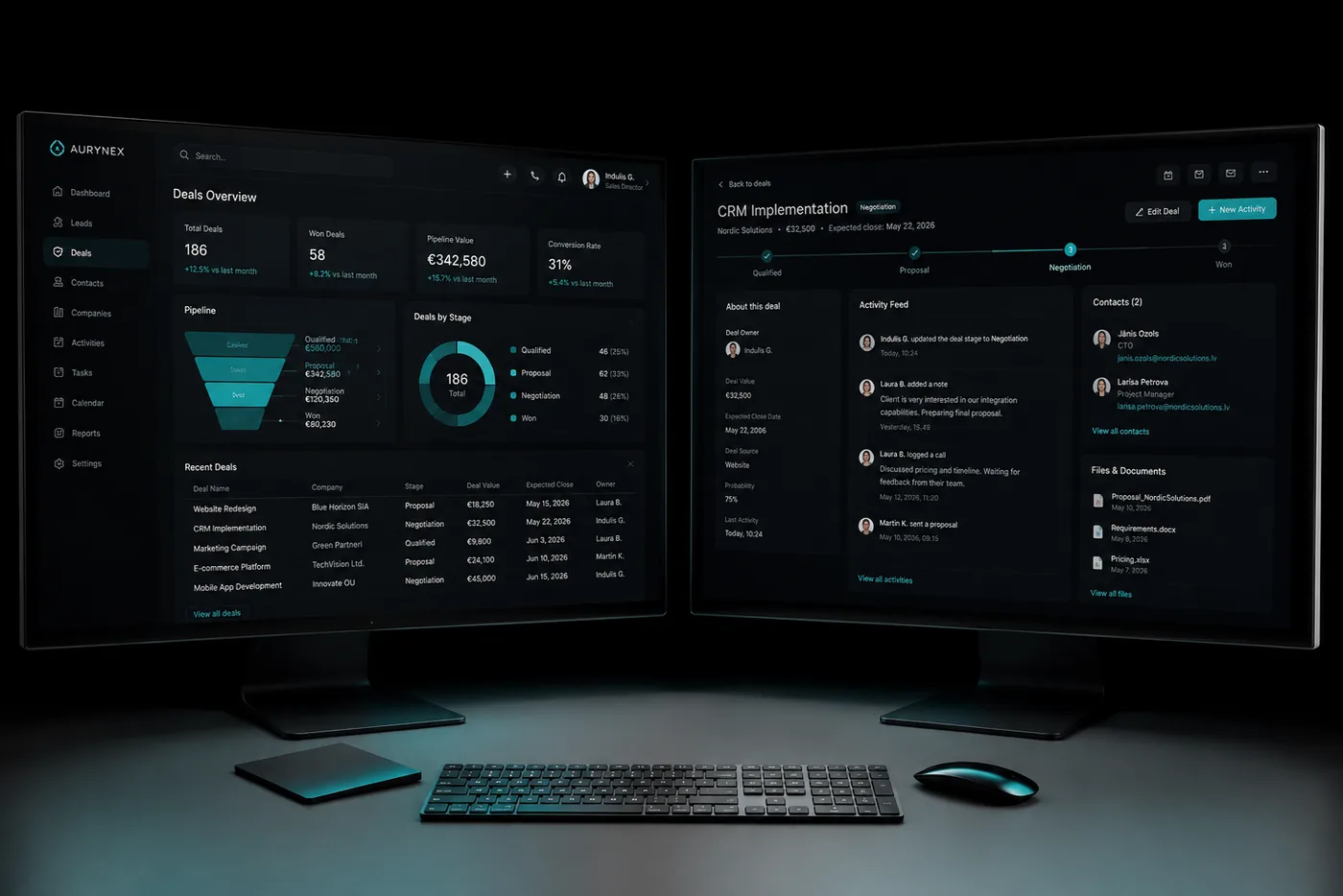
Custom HubSpot and NetSuite integration
HubSpot and NetSuite, connected around your actual data model.
- Typical range$8,000 – $35,000 depending on object count and mapping complexity
- Timeline3–8 weeks
A custom HubSpot NetSuite integration syncs deals, companies and orders between the two systems using field mapping specific to your setup. Packaged connectors cover standard objects well but struggle with NetSuite custom records, non-standard field mapping, and cases where both systems need to stay authoritative for different fields. Custom work is warranted when any of those apply.
When a packaged HubSpot NetSuite connector is not enough
- NetSuite custom records and custom fields are frequently outside what a packaged connector can map.
- Deal-to-sales-order translation rarely maps one-to-one: line items, pricing rules and tax treatment usually need business logic rather than a field pairing.
- Both systems tend to be authoritative for different fields, which requires a per-field source of truth rather than a single sync direction.
- NetSuite's API has real rate and concurrency limits that a naive sync will hit at volume.
What has to be mapped
The objects that need a decision before any code is written, and the ones that most often go wrong.
| Object | Decision |
|---|---|
| Company ↔ Customer | Usually the record that needs a definitive source of truth first |
| Deal ↔ Sales Order | Not a one-to-one map: line items and pricing need explicit rules |
| Contact ↔ Contact | Watch for duplicate handling and which side owns email changes |
| Product / SKU | Pricing and availability usually flow NetSuite → HubSpot, one way |
| Invoice / payment status | Typically NetSuite → HubSpot so sales can see payment state |
| Custom records | The most common reason a packaged connector is not sufficient |
What actually goes wrong
Sales order creation timing out at volume
Order creation involving many line items can exceed request limits. It needs queueing and asynchronous processing rather than a synchronous call per record.
Duplicate customers from parallel creation
If both systems can create a customer, you need a deterministic matching key and a decision about which side wins: before the first sync runs, not after.
Silent partial failures
A sync that writes the header and fails on a line item leaves an incomplete order. Failures must be atomic and visible, with a retry path.
Common questions
If your objects and fields are standard and you only need a one-way sync, use one. It will be cheaper and faster. Custom work becomes necessary when NetSuite custom records are involved, when deals do not map cleanly to sales orders, or when both systems need to remain authoritative for different fields.
Typically $8,000 to $35,000. The main drivers are how many object types are in scope, whether the sync runs one way or both, and how much business logic sits between the two data models. Deal-to-order translation is usually the largest single piece.
Yes, but two-way sync requires a source of truth defined per field rather than per record. That is a design decision made up front, and it is the thing that prevents overwrites and duplicates later.
Failures are logged with the record and the reason, retried where retry is safe, and surfaced as an alert rather than sitting in a log nobody reads. Any integration without a visible failure path will eventually cost more than it saved.
Start with the problem, not the software
Tell us what the process looks like today and where it breaks. You will get an honest read on whether it is worth building, what it would take, and roughly what it would cost, in writing, before anyone signs anything.
- Emailinfo@ilgoldberg.com
- Supportsupport@ilgoldberg.com
- Phone+1 (302) 307-3958
- Overlap8am to 12pm ET