
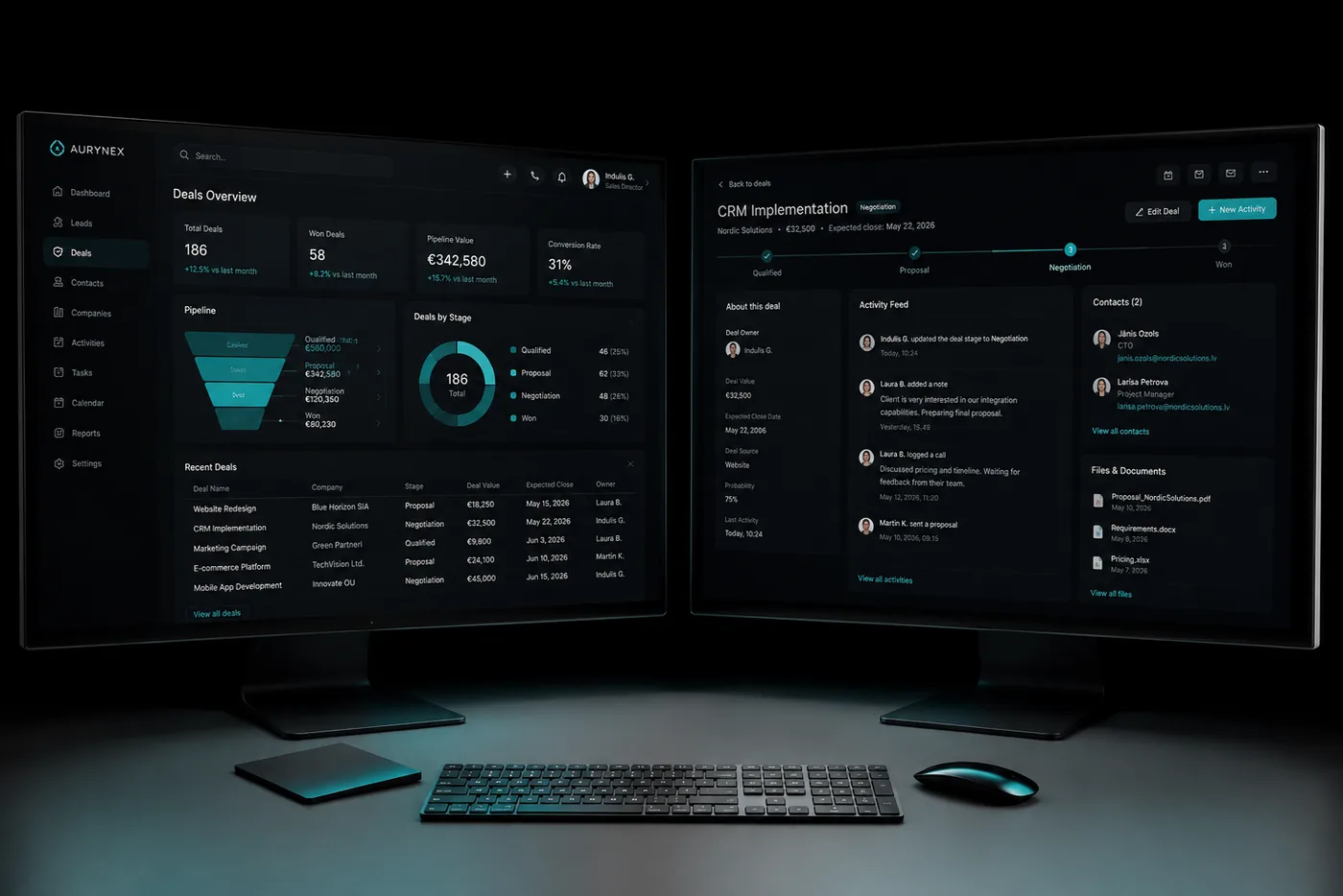
Chose a system they own outright over an established ERP vendor, cutting five-year cost by roughly half.
- SectorMedical distribution
- Size43 staff
Contracted and in build. Go-live is set for the client's fiscal-year cutover on 1 January 2027, the one point in the year an accounting system can be switched cleanly.
Where they were
The situation before any of this was built.
The company ran a major vendor ERP alongside a separate business-intelligence product, on monthly subscriptions that never stopped and never produced anything the company owned. Over five years that stack was on track to cost roughly three times what replacing it outright would.
Per-user licensing was the real constraint. With 43 employees and a budget that covered roughly 23 to 25 seats, access had to be rationed. People who needed stock and order data worked from exported spreadsheets that were stale the moment they were sent, because a seat for them could not be justified.
Medical goods carry lot and expiry tracking obligations that general-purpose ERP handles awkwardly, and the data itself is sensitive enough that where it physically lives is a real question rather than a procurement formality.
What we built
We proposed a system the company owns rather than rents, running on their own server. Thirteen modules covering clients, sales, warehouse with lot and expiry tracking, purchasing, finance, service, non-conformities, personnel and payroll, ecommerce, reporting, contracts, permissions, and a digital marketing module.
Because there is no per-seat fee, the licensing constraint disappears by design rather than by budget increase. All 43 employees get access, and so does everyone hired later.
The contract hands over full source code, database schema and technical documentation at project close. Twelve months of support and corrections are included after go-live, with no hourly cap, after which support is optional and priced from actual usage rather than a mandatory subscription.
The build reuses roughly 60% of an existing platform we already maintain, which is why a system of this scope is economic at this size of company at all.
What changed
Selected over an established ERP vendor
Won competitively on ownership, on-premise deployment, unlimited users and total cost, not on headline price alone.
Five-year cost roughly 45% lower
Against the competing vendor bid, and roughly a third of what the incumbent system was on track to cost over the same period.
43 users instead of 23
Per-seat licensing removed entirely, so access is decided by who needs the data rather than by what the license budget allows.
Source code handed over
Code, schema and documentation transfer at project close. No lock-in to us as a supplier.
Built with
We are happy to walk through either of these in detail on a call, including the parts that went slowly.
Start with the problem, not the software
Tell us what the process looks like today and where it breaks. You will get an honest read on whether it is worth building, what it would take, and roughly what it would cost, in writing, before anyone signs anything.
- Emailinfo@ilgoldberg.com
- Supportsupport@ilgoldberg.com
- Phone+1 (302) 307-3958
- Overlap8am to 12pm ET