
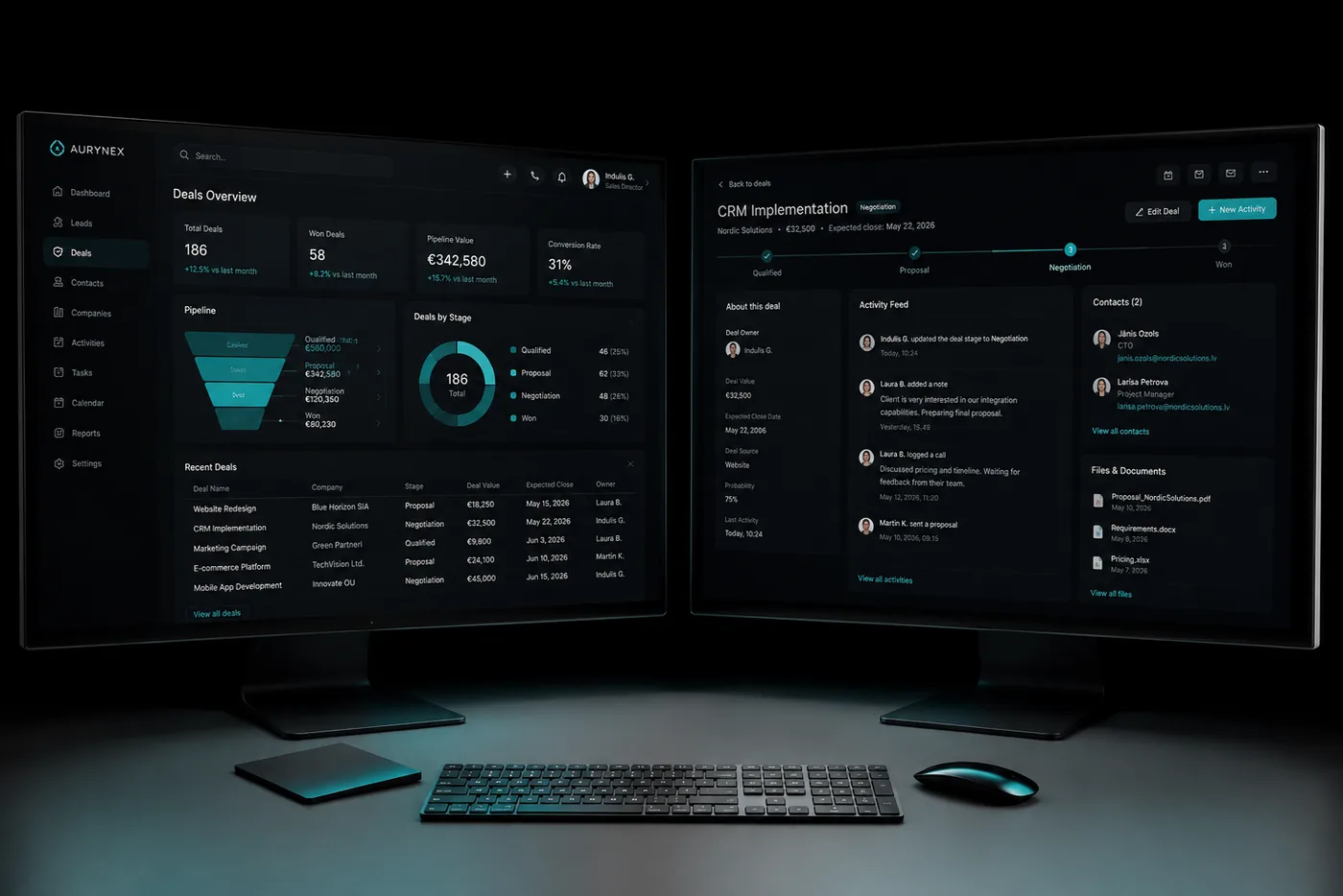
Custom CRM vs Salesforce: which is right for your business?
- TypeComparison
- Reading time9 min
- Updated2026-08-18
Salesforce suits organizations that want a mature ecosystem, standard sales processes and no responsibility for maintenance. A custom CRM suits organizations whose process is genuinely non-standard, whose per-seat costs scale badly, or who need to own the system outright. The deciding factor is usually how much of the platform you would actually use.
Where Salesforce genuinely wins
A vast ecosystem of pre-built integrations and a large hiring pool of people who already know it.
Standard sales processes handled well out of the box, with no build time.
Someone else is responsible for uptime, security patching and platform upgrades.
If your process is broadly conventional and you value speed to deployment over fit, this is the right answer and we will say so.
Where a custom build wins
When your process is a competitive difference rather than an inconvenience. Bending it to fit a platform removes the thing that makes it valuable.
When per-seat pricing has begun rationing access to your own data, the point at which some staff work outside the system and the data stops being reliable.
When you need the system to run on your own infrastructure for policy, residency or cost reasons.
When you would use a small fraction of what you are licensing.
The honest cost comparison
Compare over five years, including implementation, and be realistic about which edition you would actually need.
| Licensed platform | Custom build | |
|---|---|---|
| Year one | Lower, licenses plus implementation | Higher, the build |
| Ongoing | Recurring per seat, rising with headcount and price increases | Hosting plus optional maintenance |
| Cost of growth | Scales with users | Largely flat |
| Ownership | You rent access | You own the asset |
| Exit | Data export, process rebuild | You already hold the code |
The signals that decide it
You are on a custom path if: license cost is deciding who gets access, a parallel spreadsheet has become load-bearing, or your team describes the CRM as something they work around.
You are on a platform path if: your process is broadly standard, you need to be live in weeks rather than months, or you have no appetite for owning a system.
Most companies are genuinely on the platform path. The ones that are not usually already know it.
Common questions
Different, not necessarily harder. A licensed platform means someone else patches the infrastructure but you absorb their upgrade cycle and their roadmap decisions. A custom system means you control both, and you carry responsibility for hosting and updates: which is straightforward with documented, conventional technology and a real handover.
A custom system grows by being extended, which is the normal path. The genuine risk is not outgrowing it but building it in a way only one team can maintain: which is why source code, schema and documentation should be delivered throughout, not at the end.
Yes. Accounts, contacts, opportunities and activity history all migrate. The decision is usually how far back to bring history, since older data increases cost while decreasing in usefulness.
Read next
Start with the problem, not the software
Tell us what the process looks like today and where it breaks. You will get an honest read on whether it is worth building, what it would take, and roughly what it would cost, in writing, before anyone signs anything.
- Emailinfo@ilgoldberg.com
- Supportsupport@ilgoldberg.com
- Phone+1 (302) 307-3958
- Overlap8am to 12pm ET